


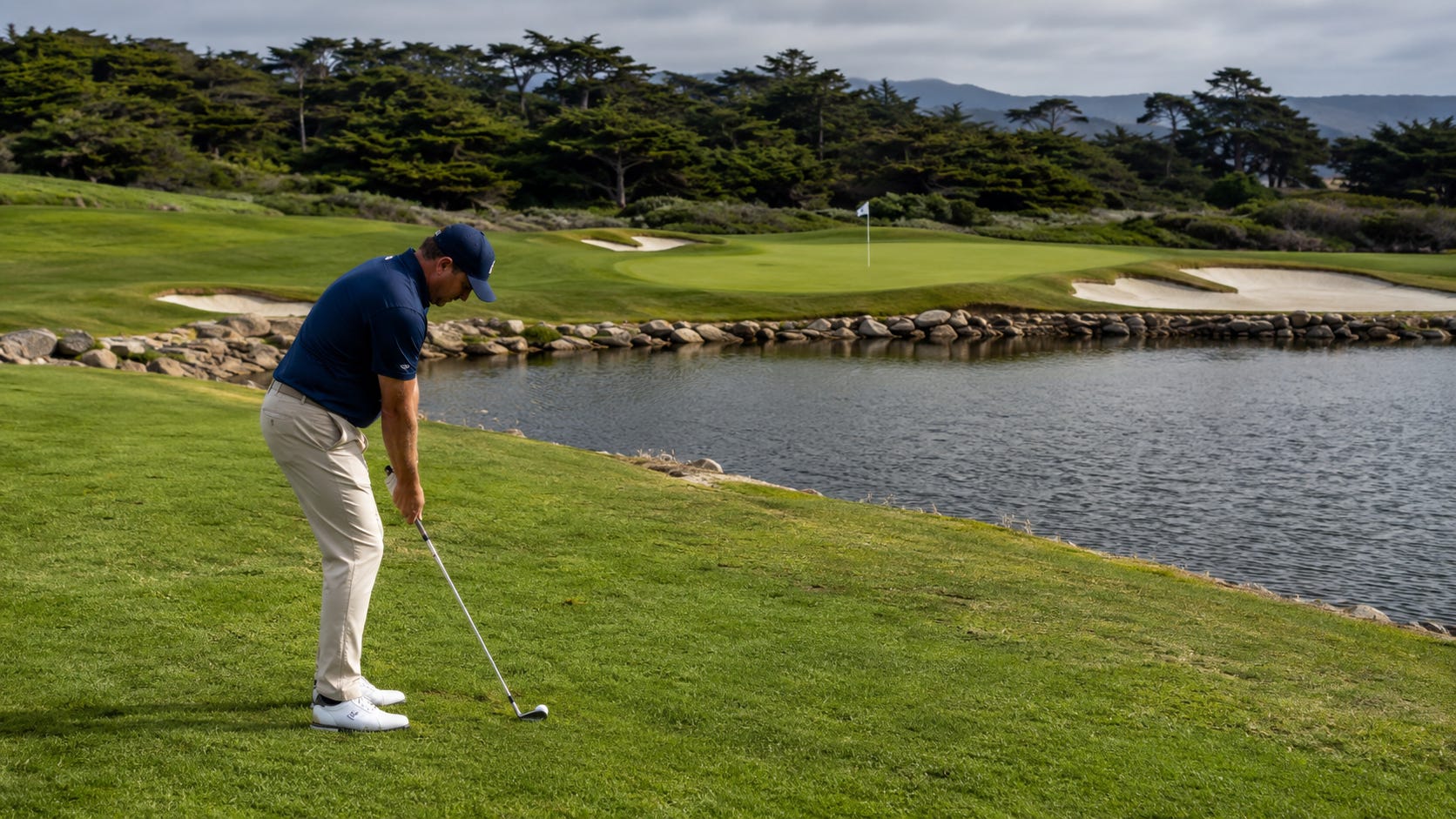
I have a favorite fairway wedge shot that seems like I’ve hit 1000 times. 67-yards, it is a perfect half wedge swing for me. When I see it in the range finder, a confident smile appears.
Sometimes, there is a strange moment every seasoned player knows about. You stand over your favorite shot, great lie, perfect distance, nothing unusual about it. Then, for some reason, the thoughts start to creep in. Suddenly, you are trying to remember what was working yesterday on the range. You start thinking about your takeaway, position of your hands… whatever!
All of a sudden you have multiple thoughts going on. For a few seconds, You are frozen over the ball. Tired of waiting, you pull-the-trigger. Now you are in scramble mode, and you have lost your feel.
I have been there more times than I care to admit. And the strange part is, the better you know your swing, the easier it can be to fall into this trap.
We Have a Lot of Swing Thoughts in Our Library
Seasoned players have history. We take lessons and try new drills. We watch YouTube videos and spend hours grinding on the range. We have old fixes that worked for three weeks and new fixes that replaced the old fixes.
We have spent years collecting information about our golf swings. So, when something does not feel quite right, or when a shot starts to matter, we have plenty of places to go looking for help.
Pick your favorite swing thought, but the problem is not that those thoughts are always wrong. Because they are not, some of them most likely helped you build your motion in the first place. The problem is not that you have swing thoughts. The problem is when you use them.
There is a significant difference between working on a swing movement during training and trying to work on that movement while you are playing golf. I did not understand that distinction for a long time. I figured if a swing thought helped me on the range, it should help me on the course. So, I carried a swing thought with me, sometimes two of them, sometimes three. Not only that, but I had separate swing thoughts for the driver, the putter, and the wedges.
That is a crowded place from which to play golf.
The Shot Gets Harder When You Start Watching Yourself Hit It
Think about something you do naturally. If you are tossing a set of keys to someone, you do not think about wrist hinge or exactly how much your elbow bends. You look where you want the keys to go and throw them.
But we tend to do something different when the shot matters. We start looking at what is going on above the ball. Now we are not simply hitting the fairway wedge 67 yards, we are watching ourselves hit the wedge 67 yards.
That is quite a different job. And for a seasoned player, it can create a mess in a hurry. We know how to hit this shot, the swing is already in there, we have made it thousands of times. But instead of letting the trained motion respond to the shot, we start managing it piece by piece. That is when our favorite swing can suddenly feel like something you have never done before.
I Learned More From a 28-Putt Round Than I Expected
One of the rounds that changed how I thought about this had nothing to do with a perfect putting stroke. I had 28 putts… I know, but did you know that the best putters on the PGA tour, average 28 putts per round. This dates back 20 years or so. Ok, back to me, the first time I had 28 putts in a round.
What I remember most is not some mechanical breakthrough with the stroke. In fact, I do not remember thinking about the mechanics of my stroke much at all. I remembered picking the line. I remember having had a clear picture of where I wanted the ball to go. I settled on the speed and then I pulled the trigger.
The weird thing, I did this for 18 holes. That was about it, that is all I can remember. As the round went along, I seemed to trust myself more. Not because I suddenly discovered some secret move with my hands or shoulders.
I simply stopped getting in the way. That stuck with me then and still does. Because like a lot of serious players, I had spent years believing that more control would eventually produce more consistency.
But there are times when more conscious control does exactly the opposite. Especially with scoring shots. Fairway wedges inside 120 yards, distance putting, little feel shots around the green, and especially 4-foot putts. These are not just swing motions; they are distance problems. You have a target and you have a required amount of energy to hit the ball the correct distance. And you need your body to respond to what you see and feel.
If your attention is buried inside the movement, it becomes pretty difficult to stay connected to the distance you are trying to create.
Mechanics Still Matter
I want to be clear about this. Blackout Mode does not mean mechanics do not matter. They do matter. If your setup is poor, work on it. If your stroke needs work, work on it. If there is something in your wedge motion that needs to change, train the change. That is what practice is for.
But slow it down. Train at home, without a ball, and rehearse the motion until it becomes implicit memory. Do what you need to do to build it. But at some point, you have to stop working on the motion and start asking the motion to perform. That is when you go to the range, work on distance control without conscious thought of course.
But you cannot spend the entire week teaching your body something and then stand over a shot Saturday morning going through your checklist. At some point, you have to let it go.
For me, that is the moment I pull the trigger.
Before the trigger:
Pick the club.
Know the distance.
Pick the landing spot (target).
Feel it (love that word).
The pre-shot | pre-putt routine.
Once I am ready to go, the mechanical conversation needs to end. Now I am Pulling the Trigger.
Try This With Three Shots
Here is a straightforward way to see how quickly your mind tries to get involved. You can do this with a wedge or a putter.
Pick one clear intentional target. For a wedge, which might be a landing spot. For a putt, it might be a spot on the green or a clear picture of the ball rolling to the hole. It is different for everybody.
Then, hit three shots, only three. For each one, stay with that image of the target all the way through pulling the trigger. No swing thoughts or coaching.
See the shot.
Go through your routine.
Pull the Trigger.
After three shots, write down every mechanical thought that tried to sneak in. You may be surprised how busy your mind gets. Give yourself one point for every shot where your original target image was still clear when you pulled the trigger.
Three shots, three possible points. This is not a test of whether swing thoughts are good or bad. You are simply noticing where your mind goes when you stop giving it something mechanical to manage.
Pay Attention to the Thought That Keeps Coming Back
There is usually one every seasoned player seems to have, an old favorite sitting on the bench waiting to get called into the game. Whatever it is, do not fight with it, just notice it. Then ask yourself one question:
Did that thought actually help me control the distance?
That question cuts through a lot of noise. Because the objective is not to produce a technically correct swing or stroke. The objective is to hit the ball the right distance.
If the thought is helping you train a movement, fine… train it. But if you are standing over a scoring shot and that thought is pulling your attention away from the target, it may have already done all the good it is going to do.
Leave it for training at home.
You Do Not Need to Forget Everything You Know
Seasoned players sometimes hear “play by feel” and assume it means throwing mechanics out the window. That is not what I am talking about here. You spent years building your golf game so keep the useful work and keep learning.
But do not confuse knowing something about the golf swing with needing to think about it while the club is moving. Those are two different things. Train the motion when you are training, prepare the shot when you are preparing, and then let the shot happen.
That sounds simple because it is simple. That does not mean it is easy. For a range grinder who has spent years trying to fix the next thing, trusting a motion without trying to fix it can feel almost irresponsible at first.
I know… I lived that way for a long time. But there comes a point when another swing thought is not the answer. Sometimes the next step is giving the work you have already done a chance to show up.
One target.
One feel.
One image.
Then Pull the Trigger.
Journal Prompt
Which mechanical thought shows up most often when “a shot matters?” And does it actually help you control the distance?
I would be interested to hear yours. Most seasoned players have one.
Train trust, not swing thoughts.
Scott | Distance Control Coach
Train Differently
If you want to get more out of your practice, start by tracking what actually matters.
Free subscribers get practical training lessons each Tuesday on feel, trust, routine, reflection, and distance control inside 120 yards.
Paid members get full training sessions, practice plans, journal prompts, and course-transfer assignments designed to help you train week after week.
Keep using your journal to capture what clicked, what needs work, and what you will train next.