


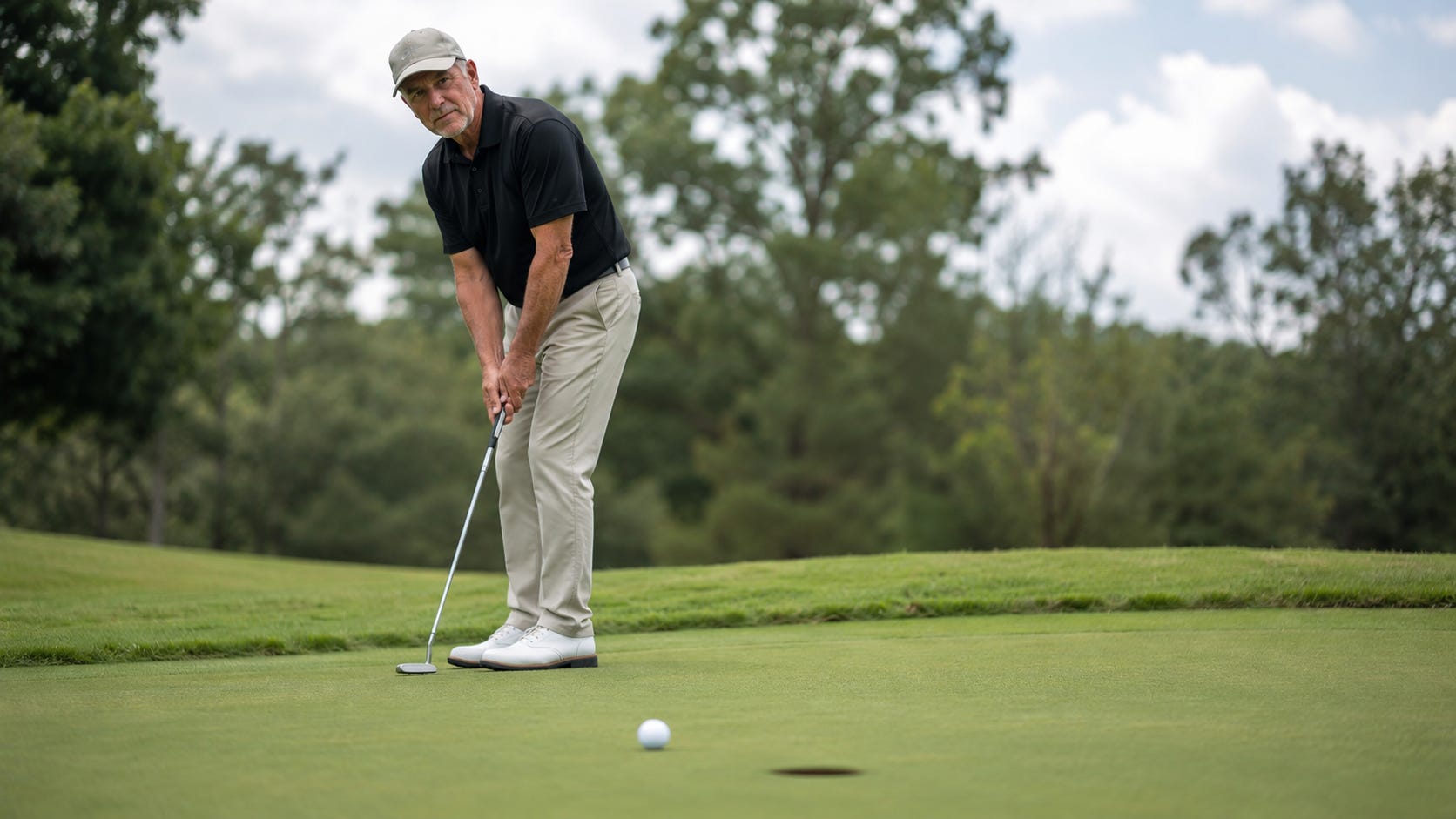
Has this happened to you?
You are standing over your favorite wedge shot. Maybe it is 60-yards and dead center in the fairway. It is a wedge you have hit seemly 1000 times on the range and golf course. You know the yardage and which wedge is perfect for this shot.
As you step in, you know you have made this swing before. Then all of sudden, the swing thoughts begin. It might be a reminder of what swing thought(s) was working on the range the day before. By the time you take the club back, you are trying to manage two or three different thoughts at once.
The same thing can happen on the putting green.
You see the line and you know the speed matters. But instead of reacting to what you see, you start thinking about your shoulders, your putter face, your takeaway, and whether your stroke is square at impact.
At this point, you are no longer hitting a golf shot, you are supervising a movement.
You are no longer hitting a golf shot, you are supervising a movement. That is the problem Blackout Mode Golf is designed to solve.
What Blackout Mode Does Not Mean
Blackout Mode does not mean zoning out. It does not mean guessing, ignoring mechanics, or pretending technique does not matter. It is not a mental, positive thinking trick. It does not mean you have to try harder to focus. And it is certainly not standing over the ball with an empty mind and hoping your body knows what to do.
Blackout Mode begins before you ever reach the course. It begins in training where you work on the motion. You build the setup, and repeat the motion of the swing or stroke often enough to build implicit memory. You learn stock distances, how to adjust speed, and learn to pay attention to feel.
Most importantly, you train with your pre-shot and pre-putt routine. Then, when it is time to play, you stop dragging swing thoughts or you last lesson onto the course with you.
The Work Has Already Been Done
Blackout Mode means the work has already been trained. You have built trust through repetition of the swing or putting motion, feel for distance control, and your pre-shot or pre-putt routine.
You have rehearsed the movement enough that you have built implicit memory and do not need to consciously control every part of it. That does not mean your technique is perfect.
It means you have decided that the moment you pull the trigger is no longer the moment to rebuild your swing or putting stroke.
There is a time to work on mechanics and there is also a time to play golf. Seasoned players often struggle because they never clearly separate the two. They take a practice thought to the range, then carry it to the first tee, then drag it through all 18 holes.
Every shot becomes another inspection or lesson. Blackout Mode creates a boundary by training the movement first then trusting the movement when it matters most on the golf course.
The Round That Helped Me Understand It
The idea became clear to me after my first round in which I had 28 putts. I did not walk off the course thinking about my stroke mechanics. I could not have told you where the putter was at any particular point in my stroke motion.
I was not checking my shoulders or guiding the putter face. I was seeing the putt, feeling the distance, trusting my routine, and pulling the trigger without ANY thought of right or wrong. There was no struggle to manufacture confidence. There was simply less interference.
That round helped me understand something I had experienced before but had never clearly defined:
Some of our best golf appears when the work has been trained deeply enough that we can get out of the way.
That is Blackout Mode.
Mechanical Practice and Trained Trust
Mechanical practice has an important job because it helps you build a movement that can hold up. You may need to work on your setup, swing length, balance, tempo, face control, or contact.
But mechanical practice is only the first part of the process. Eventually, the seasoned player must move from correcting the motion to repeating a motion they can feel and trust. Once you start trusting yourself it is time to move towards performance. This final step is where many seasoned players get stuck.
They continue consciously controlling a motion that should gradually be moving into implicit memory. They know more about the swing than ever, but they trust it less. Blackout Mode Training is the bridge between working on a motion and being able to use it when it matters most, without thinking your way through it.
What It Looks Like on a Wedge Shot
Imagine you have 70 yards to the hole. During training, you have already built a stock swing for that distance range. You know the wedge and length of back swing and finish position. You recognize the tempo because you have rehearsed the shot at home and tested it on the range.
On the course, your job is not to recreate all of those lessons. Your job is to choose the shot, feel the target, perform your pre-shot routine, and pull the trigger.
That is it.
The swing thought is not a list of body positions. It may be nothing more than a picture of the target and a clear sense of the motion.
Then you let it go.
That is not careless golf.
That is trained trust.
What It Looks Like on a Putt
Now imagine a 30-foot putt. You have practiced speed control. You have trained yourself to look at the line and distance, feel the size of the stroke, and connect that feel to the target.
When you step into the putt, you are not trying to steer the ball to the hole. You are not checking whether the putter moved perfectly on the way back.
You simply perform your pre-putt routine:
You settle in.
You take a mental picture of your target.
Bring your eyes back to the ball.
Pull the Trigger.
Your attention stays with the putt rather than turning inward toward your mechanics. Again, this is not guessing.
The freedom comes from preparation.
Commitment Instead of Conscious Control
Blackout Mode is not about trying harder or putting in less effort. It is about directing effort toward the right things.
Before the shot, you make a clear decision:
You choose the club.
You choose the target.
You choose the type of shot.
You commit to the routine.
Once you step in, you stop trying to consciously control the entire motion. You allow the swing or stroke you trained to show up. That is the difference between commitment and control.
Control says:
“I need to make every part of this movement happen correctly.”
Commitment says:
“I have prepared for this shot. Now I am going to trust it.”
One Simple Takeaway
The next time you practice, decide which mode you are in. Are you working on the movement? Or are you training yourself to trust it? Both matter, but they are not the same type of practice.
Try this:
Spend part of your session making corrections.
Then give yourself a few shots where the correction is finished.
Choose the target.
Use your routine.
See the shot.
Build your image of the target.
Bring your eyes back to the ball and…
With your image fresh in your mind—Pull the Trigger.
Let the motion happen without checking it.
That is where Blackout Mode begins. Not by thinking less during every part of the process. By doing the thinking during training so you do not have to carry it into the shot.
Keep training,
Scott Alford
Golf Distance Control Coach
Creator of Blackout Mode Training
Train differently
The Blackout Journal is for seasoned golfers who have spent years working on mechanics but still want more trust when the shot counts.
Subscribe free to The Blackout Journal for weekly notes on training trust, feel, and distance control inside 120 yards.