


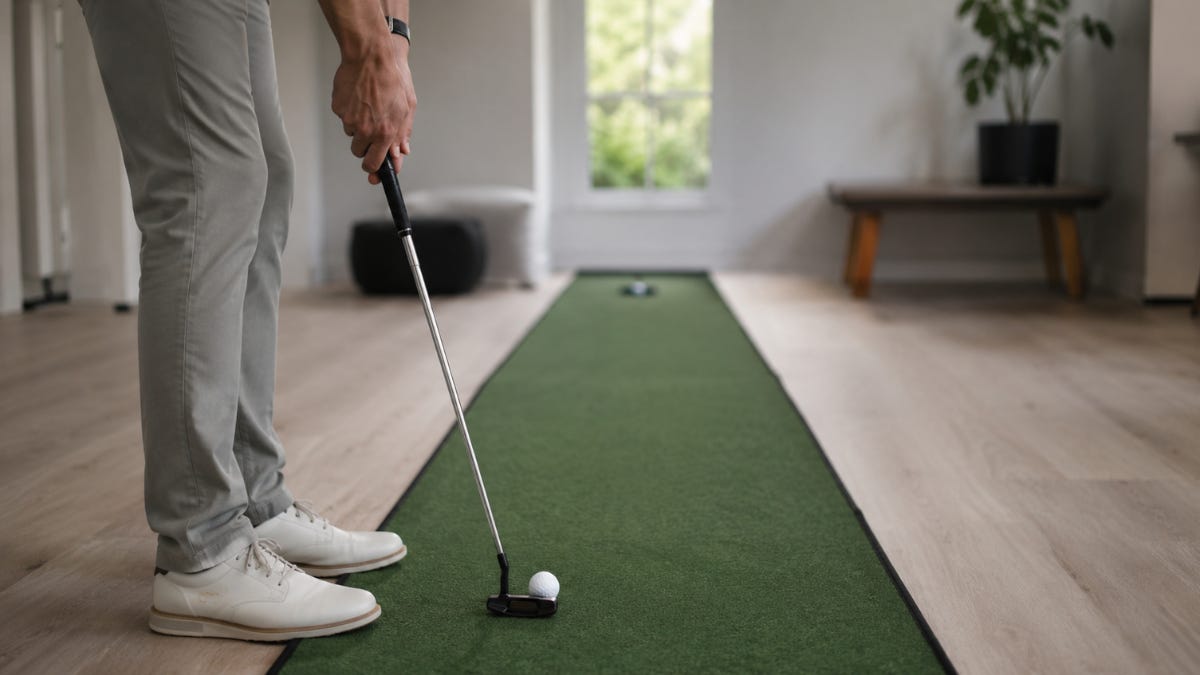
A seasoned player leaves a 35-footer six feet short and immediately starts looking for a putting stroke answer. A pretty ordinary speed mistake turns into a putting lesson.
I have done enough of that myself.
There is another way to work on it. Put one ball on the green and use that ball to tell your eyes where the next one should finish. That is essentially what leapfrog putting does. The previous ball gives you a distance problem. It does not tell your hands how long the stroke needs to be.
That difference is why I like it.
You roll one ball. The next needs to finish a little farther away, or just past the first one. Then the next goes a little farther still. Your eyes see a changing finish, and the stroke has to respond.
There is no ruler beside the putter. No six-inch backswing for one distance and eight inches for another. Just a new place for the ball to stop. But there is a weakness in the way this drill is often practiced. Seasoned players get pretty good at adding speed because the whole exercise keeps moving in one direction. Short, longer, longer again. After a few balls, you start anticipating what comes next.
Golf does not work that neatly. Sometimes the next putt is longer and sometimes it is shorter. You might have a 45-footer on one green and a 22-footer five minutes later. You have to take speed away just as often as you add it. That is why the reverse ladder matters just as much as the forward one. And once both directions start feeling comfortable, I want to take the order away completely.
Before you get into the full session, try a simple version:
Roll one ball to a comfortable spot.
Roll the next one so it finishes a little beyond the first.
Do the same with a third.
Then reverse it.
Start from your longest reference and see if the next ball can finish a little shorter, followed by another one shorter still.
Do not measure your stroke and watch the space between the balls. You may find one direction feels almost automatic while the other takes considerably more attention.
That is useful information.
