
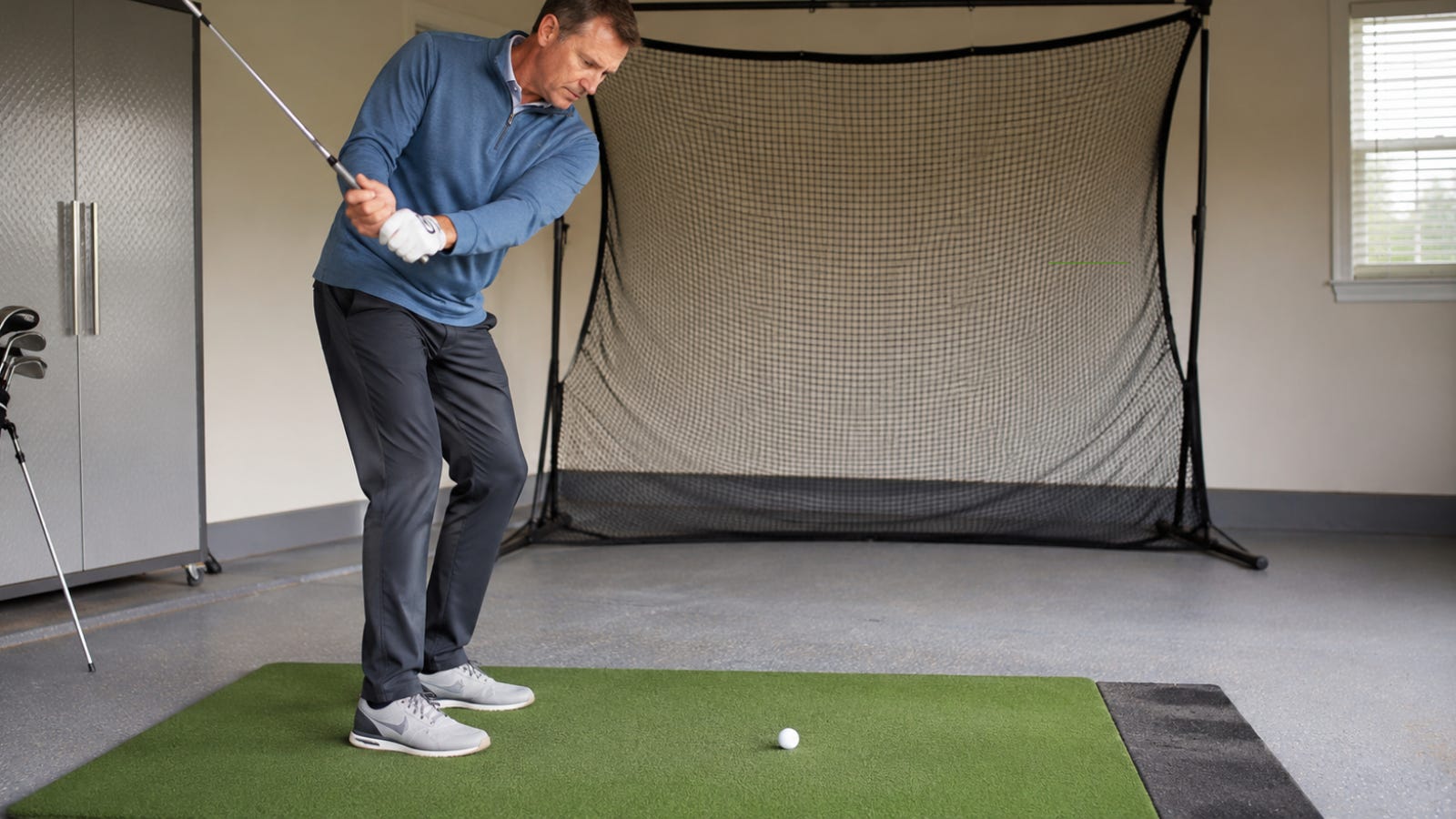
The 20-Minute Wedge Trust Session
A simple at-home session to start building three wedge swings you can actually trust.
Most seasoned players do not need more wedge thoughts.
They already have enough or know where to find them.
Take it back shorter.
Keep the face square.
Don’t quit on it.
Accelerate through.
Hold the finish.
Clip it clean.
Those thoughts may sound useful on the practice range.
But over a 60-yard wedge shot on the course, too many instructions start to get in the way.
The motion gets careful.
The body starts steering.
The player is no longer feeling the shot, just trying to manage it.
That is not trust.
And wedge distance control is hard to build without trust.
This 20-minute session is designed to help you start training three simple wedge motions you can recognize, repeat, and eventually take to the course.
Not perfect swings.
Trusted swings.
That is the difference.
The Goal of This Session
Inside 120 yards, the goal is not to swing harder or softer every time you see a different number.
That gets messy.
One day the swing feels smooth.
The next day it feels rushed.
One shot comes out dead.
The next one jumps.
Instead, we want to build a simple baseline.
Three stock wedge motions:
Hip to hip.
Rib to rib.
Shoulder to shoulder.
These are not meant to make you robotic.
They are meant to give your body a few familiar patterns.
A short motion.
A medium motion.
A longer controlled motion.
Once those patterns become familiar, you have something to build from.
That is where feel starts.
That is where wedge trust starts.
Why We Train This at Home
At home, you are not chasing ball flight.
That is a good thing.
There is no flag to impress.
No bad shot to judge.
No range session turning into a swing lesson.
Just movement, rhythm, learning how far the club travels, and what each motion feels like.
You can use a real wedge.
You can use a plastic ball or foam ball.
You can rehearse without a ball at all.
I use all three. I try to rotate each time I do the drill. You will discover, by removing the golf club from the equation, your focus shifts towards body movement and away from the result of club position.
You will thank me later.
The point is not the result.
The point is the pattern.
If you can train the motion without needing feedback from the ball every time, you start building something deeper than a range habit.
You start building a swing you can recognize.
And a swing you can recognize is easier to trust.
The Three Wedge Motions
The session is built around three stock wedge swings from the Blackout Fairway Wedge System.
1. Hip to Hip
This is your compact pitch motion.
Low effort.
Smooth acceleration.
Simple finish.
Your hands and club travel about hip height on the backswing and hip height on the follow-through.
Do not make it tiny.
Do not jab at it.
Just let it move.
2. Rib to Rib
This is your middle wedge motion.
Comfortable rhythm.
Solid but not forced.
Your normal controlled wedge swing.
The club travels to about rib cage height on both sides.
This is the one many golfers will use often once they learn to trust it.
3. Shoulder to Shoulder
This is your longer controlled wedge motion.
Not a full swing.
Not a hard swing.
Controlled power.
The club travels about shoulder height back and through.
The key word is controlled.
Aggressive enough to move the ball, but not so hard that you lose the shape of the motion.
What This Session Trains
This session trains five things:
Swing length.
You begin to know what each stock wedge motion feels like.
Rhythm.
You stop rushing the short one and forcing the long one.
Routine.
You begin every motion with a clear intention.
Commitment.
You call the swing before you make it.
Trust.
You stop judging every move and start letting the body learn.
That is the whole point.
You are not trying to leave this session with a perfect wedge swing.
You are trying to leave with three motions that feel a little more familiar than they did when you started.
That is enough for today.
A Simple Preview
The full session below walks you through all 20 minutes.
But the idea is simple:
Start quiet.
Rehearse the motion.
Train hip to hip.
Train rib to rib.
Train shoulder to shoulder.
Then finish by mixing the three motions so you are not just repeating the same swing mindlessly.
That last piece matters.
Golf does not hand you the same wedge shot five times in a row.
So eventually, your training has to ask you to choose, commit, and move.
That is how practice starts becoming training.
Paid members can use the full 20-minute session below as this week’s wedge trust assignment.
Paid Subscriber Section
The Full 20-Minute Wedge Trust Session
This is your wedge trust assignment.
Do not turn it into a swing lesson.
Do not stop after every rehearsal and judge the motion.
Do not search for perfect positions.
Run the routine.
Make the motion.
Pay attention.
That is enough.
What You Need
You need:
One wedge
A little space
Indoor mat, garage space, backyard, or range
Optional plastic ball, foam ball, or just your hands together.
Your Blackout Performance Journal or a notebook
We will not hit real shots, don’t use a golf ball at all. You can put down a marker that represents ball position at address.
Keep the focus on feel and motion, not perfect ball flight, and not distance chasing.
Feel first.
Distance comes later.
Session Rule
Before every swing, call the motion.
Say it quietly to yourself:
Hip to hip.
Rib to rib.
Shoulder to shoulder.
Then make the motion.
That little step matters.
You are teaching yourself to commit before you move.
On the course, that is what you need.
Not five reminders.
One clear decision.
Minutes 0–3: Quiet Setup and Feel
Start without a ball.
Set up to your mark with your wedge, plastic ball, or your hands.
Set your posture.
Let the hands and arms hang naturally.
Make a few slow rehearsal swings.
Do not aim at anything yet.
Do not think about mechanics.
Just notice:
Is your grip relaxed?
Are your feet balanced?
Is the club moving freely?
Are you rushing before you even start?
Make 6 to 8 easy motions.
Let the club swing back and through.
Your only job is to settle down and feel the club.
A lot of golfers skip this part.
They grab the wedge and start performing right away.
Do not do that.
Give your body a minute to arrive.
Minutes 3–8: Hip-to-Hip Motion
Now begin the first stock swing.
Motion: Hip to hip
Feel: Low effort, smooth acceleration
Purpose: Train the compact pitch motion
Run this simple routine:
Mentally commit to the short wedge motion.
Pick a target or picture a landing area. Actual yardage does not matter yet. We are training your mind to find the target, not the distance. Could be something out the window, mark on the wall, something on the floor.
Step into your setup.
Let the clubface aim first, then set your feet. More on this later.
Look at the target and take a clear mental snapshot.
Bring your eyes back to your ball (marker).
With the image of the target fresh in your mind, pull the trigger.
Repeat this 5 times.
Do not freeze over it.
Do not rehearse or analyze. Actual position of backswing and follow through is different for everyone. We are building your stock swings, not mine.
So…
Commit and swing.
The motion should feel compact, but not cramped.
The biggest mistake here is making the swing too careful.
Let it move.
A short wedge shot still needs rhythm.
Coaching Point
Your hip-to-hip swing is not a scared swing.
It is a small swing with commitment.
There is a difference.
A scared swing slows down because the golfer is afraid of the result.
A trained short swing keeps moving because the golfer trusts the motion.
That is what you are building.
Minutes 8–13: Rib-to-Rib Motion
Now move to the middle swing.
Motion: Rib to rib
Feel: Comfortable rhythm, mid power
Purpose: Train your normal controlled wedge motion
This should feel like your most natural wedge swing.
Not lazy.
Not forced.
Just solid.
Run the same routine:
Mentally commit to the rib-to-rib motion.
Pick your target.
Step in with the clubface first.
Set your feet.
Look at the target and build your image.
Bring your eyes back to the ball (mark).
With the image of your target fresh in your mind, pull the trigger.
Repeat 5 times.
Keep the rhythm close to the hip-to-hip motion.
Do not suddenly get quick just because the swing is longer.
The length changed.
The trust should not.
Coaching Point
Most golfers start manipulating tempo here.
They make the shorter swing soft.
Then they make the medium swing quick.
Then they wonder why distance control feels different every day.
Keep the rhythm simple.
Let the swing length change the shot.
Do not force the speed to do all the work.
Minutes 13–18: Shoulder-to-Shoulder Motion
Now move to the longest stock wedge swing.
Motion: Shoulder to shoulder
Feel: Aggressive but controlled
Purpose: Train a longer wedge motion without turning it into a full swing
This is not your driver swing with a wedge.
It is not a max-effort wedge.
It is controlled power.
Run the same routine:
Mentally commit to the shoulder-to-shoulder motion.
Pick your target.
Step in with the clubface first.
Set your feet.
Look at the target and build your image.
Bring your eyes back to the ball (mark).
With the image of your target fresh in your mind, pull the trigger.
Repeat 5 times.
Finish in balance.
If the finish is falling apart, you are probably swinging too hard.
Back it down.
The goal is not to prove how far you can hit a wedge.
The goal is to train a longer wedge motion you can trust.
Coaching Point
The shoulder-to-shoulder swing should feel strong, not reckless.
You should be able to hold the finish.
You should feel the club travel.
You should still know what motion you just made.
If it turns into a full swing, you have left the purpose of the session.
Stay controlled.
Minutes 18–20: Random Feel Rehearsal
Now finish by mixing the three swings.
This is where the session becomes more like golf.
Do not go in order.
Do not repeat the same motion every time.
Call one motion before each swing:
Hip to hip.
Shoulder to shoulder.
Rib to rib.
Hip to hip.
Rib to rib.
Make 8 to 10 total swings.
Before each one:
Choose the motion. Picture the shot.
Step in. Build your image. Pull the trigger.
No extra rehearsal.
No technical checklist.
No judging.
This is the part that starts to train commitment.
You are not just building shapes.
You are building the habit of choosing a shot and letting the body respond.
That is closer to the course.
Common Mistake
The common mistake is turning this into position practice.
A golfer makes one hip-to-hip swing and immediately starts wondering:
Was that really hip height?
Was the clubface square?
Did I rotate enough?
Was my weight right?
That is not the assignment.
The assignment is to train the feel of three motions.
If you run the routine and make the motion with commitment, the rep counts.
That does not mean mechanics do not matter.
It means this session is not the place to drag ten mechanical thoughts into the room.
You are training the pattern.
You are training rhythm.
You are training trust.
What Success Looks Like Today
Success today is not hitting perfect wedge shots.
Success is:
You knew which swing you were making.
You committed before you moved.
You kept your rhythm simple.
You finished in balance.
You noticed which motion felt easiest to trust.
You noticed which one felt less familiar.
That is good training.
That is the kind of work that adds up.
Journal Prompt
After the session, write one short note.
Do not make this complicated.
Answer:
Which swing length felt the most natural today, and which one felt like it needed more trust?
Then answer:
What did I feel when the motion was free instead of managed?
That second question matters.
You are not just tracking what went right.
You are learning the difference between a motion you let happen and a motion you tried to control.
That awareness will help you the next time you train.
Next Training Assignment
Do this session three times this week.
Keep it at 20 minutes.
No more.
Do not make it bigger than it needs to be.
Each time, pay attention to one thing:
Which stock swing is starting to feel like yours?
That is the one that will become your anchor.
Once you have an anchor, wedge distance control gets easier to build.
Not because the game gets simple.
But because you finally have something you trust.
And trust is the whole point.
— Scott Alford
Golf Distance Control Coach
Creator of Blackout Mode Training
Train Differently
If you are tired of carrying swing thoughts into every wedge shot, The Blackout Journal is built for you.
Paid members get full training sessions, practice plans, journal prompts, and course-transfer assignments designed to help you train it week after week.
Keep working these three wedge motions until they feel like something you trust, not something you have to manage.


