


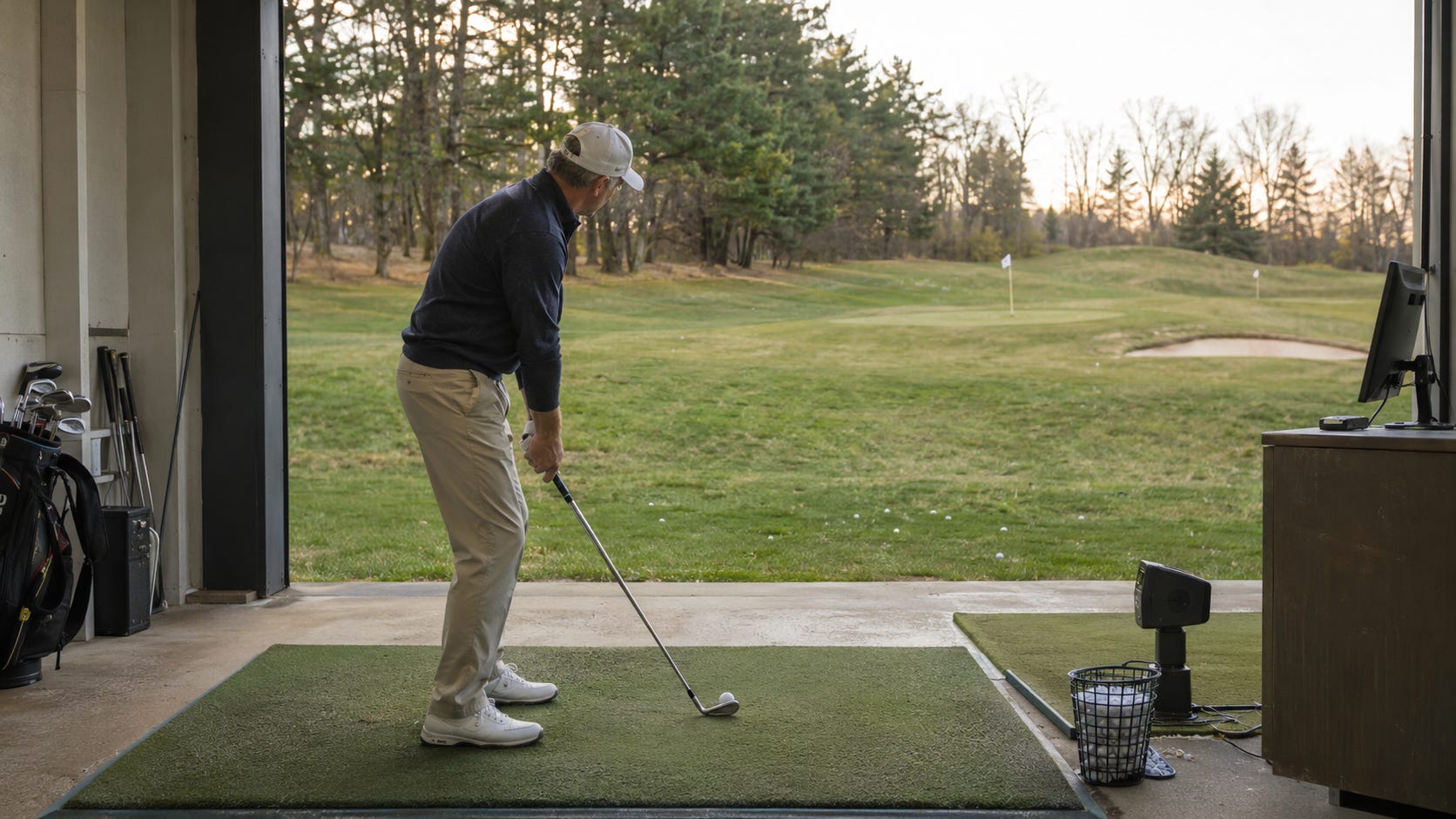
I have watched seasoned players hit to a 70-yard flag beautifully on the range and then look completely different when you give them what sounds like the same shot on the course.
But now there is a bunker in front, a front pin, a little wind, and a green that is on the firm side. Suddenly 70 yards is not just 70 yards.
Now you have to decide where the ball lands. You have to decide what flight makes sense. You have to know where you can miss. Maybe the lie changes the club. Maybe the safe shot is not the one flying directly at the flag. And unlike the range, there is only one ball.
That last part matters.
The range can take so much of that information away that we end up practicing a swing instead of practicing a golf shot. Then we wonder why the swing does not travel.
The Range Makes the Job Easier Than We Realize
Think about a normal wedge session. You laser a flag at 70 yards and drop a pile of balls. You grab the wedge you normally use and hit the first ball. Then another. Maybe the first ball is short, so the second gets a little more effort. The third ball is better. By the fifth ball, you have the number pretty well sorted out.
That can be useful practice. I am not trying to take it away from you. But look at how many decisions disappeared. You did not have to read a lie, make a decision on the club, and the target never changed.
There was no real reason to choose a safe miss. The landing spot probably stayed vague because the flag gave you something easy to aim at. And if the first ball was poor, there was another one sitting three inches away.
That is a different job than golf.
Give Me the Shot Before You Give Me the Swing
If I were standing beside you, I would want the plan before you step in.
What is the number?
What club are you hitting?
Where is it landing?
What flight are you seeing?
Where can you miss and still be fine?
Answer those first, then hit the ball. This sounds simple because it is simple. But it changes what you are practicing. Now the swing is serving a decision instead of being the whole session.
That is closer to the course.
A Flag Is Not Always a Good Enough Target
One thing I want you to notice is how often we use the flag as the entire shot.
Seventy yards to the flag… pull the trigger.
On the course, you usually know better than that. A front flag over a bunker is not the same target as a back flag with green behind it. You might be looking at the same yardage and choose a completely different landing spot. Maybe you want to carry the bunker comfortably and use the first part of the green. Maybe the green is firm, and you know the ball is going to release. Maybe the pin is not the target at all.
That decision is part of distance control.
If you never practice making it, you are leaving an important piece of the shot for the course to teach you. I would rather learn some of it on Tuesday.
The Lie Gets a Vote
This is another thing the range can hide because most practice lies are pretty friendly.
Change the lie, now the same number does not necessarily ask for the same answer. I am not saying you need to manufacture every terrible lie on the practice tee.
But when you can vary the lie, pay attention to what changes:
Maybe you choose a different club.
Maybe you will change the flight.
Maybe the landing point has to move.
That is part of the decision.
The point is not to make practice complicated. The point is to stop pretending the number is the only information that matters.
Good Practice Should Include Good Decisions
This is where a lot of seasoned players miss something. We judge practice almost entirely by the strike.
Hit it solid?
Good ball.
Hit it thin?
Bad ball.
But the golf course gives you another way to be wrong. You can make a beautiful swing to a bad target. Or you can flush the wrong club. You can hit the exact shot you pictured and still end up in trouble because the picture was poor.
That is why I want to separate the decision from the execution.
They are not the same thing.
You can make a good decision and hit a poor shot. You can also make a poor decision and get away with it.
Both tell you something.
Do Not Let a Good Strike Rescue a Bad Plan
This one is worth watching.
Suppose you give yourself a front pin over a bunker. The smart landing area is a little deeper into the green. Instead, you decide to fly it right at the flag and you catch it perfectly. The ball lands three feet away, beautiful result.
Bad practice decision.
That shot can fool you. Golf has enough luck in it already. Practice should help you see what was actually good.
So, score the plan. Not just where the ball finishes. If the decision was poor, say so even when the ball ended up close.
That is how you start taking the right information to the course.
One Ball Changes the Conversation
There is something different about knowing you only get one chance. But, you already know that. Put ten balls beside a wedge and the first one does not carry much weight. Miss the first one and you have nine more.
Give yourself one ball and suddenly the routine matters a little more. The decision matters. You tend to look at the target differently. That is a good thing.
I want some of that in practice.
Not pressure for the sake of pressure but just enough consequence that you have to complete the shot before you swing.
One ball with no mulligans, then move on.
Try Five One-Ball Scenarios
Here is the practice I want you to try.
Before you start, write five simple scoring situations on cards or in your phone.
Keep them realistic for the shots you actually face.
Something like:
70 yards, front pin, bunker short.
58 yards, plenty of green, firm landing area.
82 yards, slight wind into you.
64 yards, back pin, trouble long.
75 yards, awkward lie, safe side left.
Do not worry about making the scenarios elaborate. You just need enough information to force a decision.
Now take the first card.
Before you step over the ball, choose four things:
Club.
Landing point.
Flight.
Safe miss.
Make the plan completely then step in and use your routine. Just one ball with no do-over. After the shot, step away.
Draw the next card.
Now you have a new problem. You get five balls total, that is enough.
Score the Decision Separately From the Shot
I would give you two possible points on every ball.
One point for the plan.
Was it a good decision for the situation you created?
One point for the outcome.
Did the ball finish inside the window you chose?
That gives you ten possible points. But the number itself is not the most important part. Look at how you earned it. Maybe you made five good decisions and only hit three acceptable shots.
Fine, that tells us something about execution. Maybe you hit four good shots but only made two plans you would actually want on the course.
That tells us something different.
Do not blend the two together.
Do Not Fix the Swing Until You Know What Missed
This is where the Journal question becomes useful.
After a poor result, ask:
Was the miss caused by the plan, commitment, or execution?
Those are three different misses:
A bad plan means you chose the wrong answer before you stepped in.
A commitment problem means you had a reasonable plan and then abandoned it over the ball.
An execution miss means the plan was good, you committed to it, and you simply did not hit the shot.
Golfers tend to label all three as swing problems. That can send you down the wrong road fast. If the plan was poor, I do not need another mechanical thought.
I need a better decision.
If the plan was good but you changed your mind at address, I want to look at the routine. If both were solid and you simply missed the strike, now we may have something to train.
That is a cleaner conversation.
Practice Seeing the Shot
The real value of this kind of practice is that it forces you to use the information you are going to need later.
You have to look at the situation, decide what matters, and choose an answer.
Then the motion gets a job.
That is different from hitting balls until the motion feels good and hoping you can sort out the decisions when you get to the course.
You may already have plenty of swing. What you may not have practiced enough is calling on that swing after making one clear decision.
Do Not Turn the Range Into a Fake Golf Course
I would not do this with every ball. Sometimes the range is exactly where you should work on mechanics. Sometimes you need to hit six balls from the same number and learn something.
Sometimes you need the launch monitor. Sometimes you need repetition. Use the range for those jobs.
But eventually, give the movement something that looks more like golf:
A target decision.
A landing decision.
A club decision.
A safe miss.
One ball.
Then move on.
You are not trying to make the range look like the 14th hole at your golf course.
You are trying to preserve enough of the real job that the skill has somewhere to go when you leave the practice tee.
Here Is What I Want You to Notice
After five balls, do not start with the strike.
Look at your decisions.
Did they stay clear when the scenario changed?
Did you know the landing point before you walked in?
Did you choose the club, or did you pick it out of habit?
Did you know where the safe miss was?
Did you change the plan halfway through the routine?
That is useful information.
If the decisions stayed clear but the strike got loose, you know what needs work. If the strike was fine but the decisions were sloppy, you know that too.
That is the point.
Take the Whole Shot to the Course
A scoring shot is more than a movement. There is information in front of you. You read it, make a choice, and then you pull the trigger.
Practice should sometimes include that whole chain. Not because we need to make every range session harder. Because those decisions are part of the skill.
So, the next time you have a bucket of balls and a 70-yard flag sitting out there, do not automatically hit ten balls at it.
Give yourself one ball.
Imagine the real shot:
Where is the pin?
What is short?
What is long?
Where are you landing it?
What flight do you want?
What is the good miss?
Make the plan.
Then step in.
Now pull the trigger.
Journal Prompt
Was the miss caused by the plan, commitment, or execution?
Do not answer too quickly.
If the plan was poor, train the decision.
If you abandoned the plan, look at the routine.
If both were good and you simply did not execute, then work on the shot.
That is a much better place to start than automatically fixing the swing.
And one more question:
Which course decision do I rarely practice on the range?
Start with that one.
Train trust, not swing thoughts.
Scott | Distance Control Coach
Train Differently
If you want to get more out of your practice, start by tracking what actually matters.
Free subscribers get practical training lessons each Tuesday on feel, trust, routine, reflection, and distance control inside 120 yards.
Paid members get full training sessions, practice plans, journal prompts, and course-transfer assignments designed to help you train week after week.
Keep using your journal to capture what clicked, what needs work, and what you will train next.