


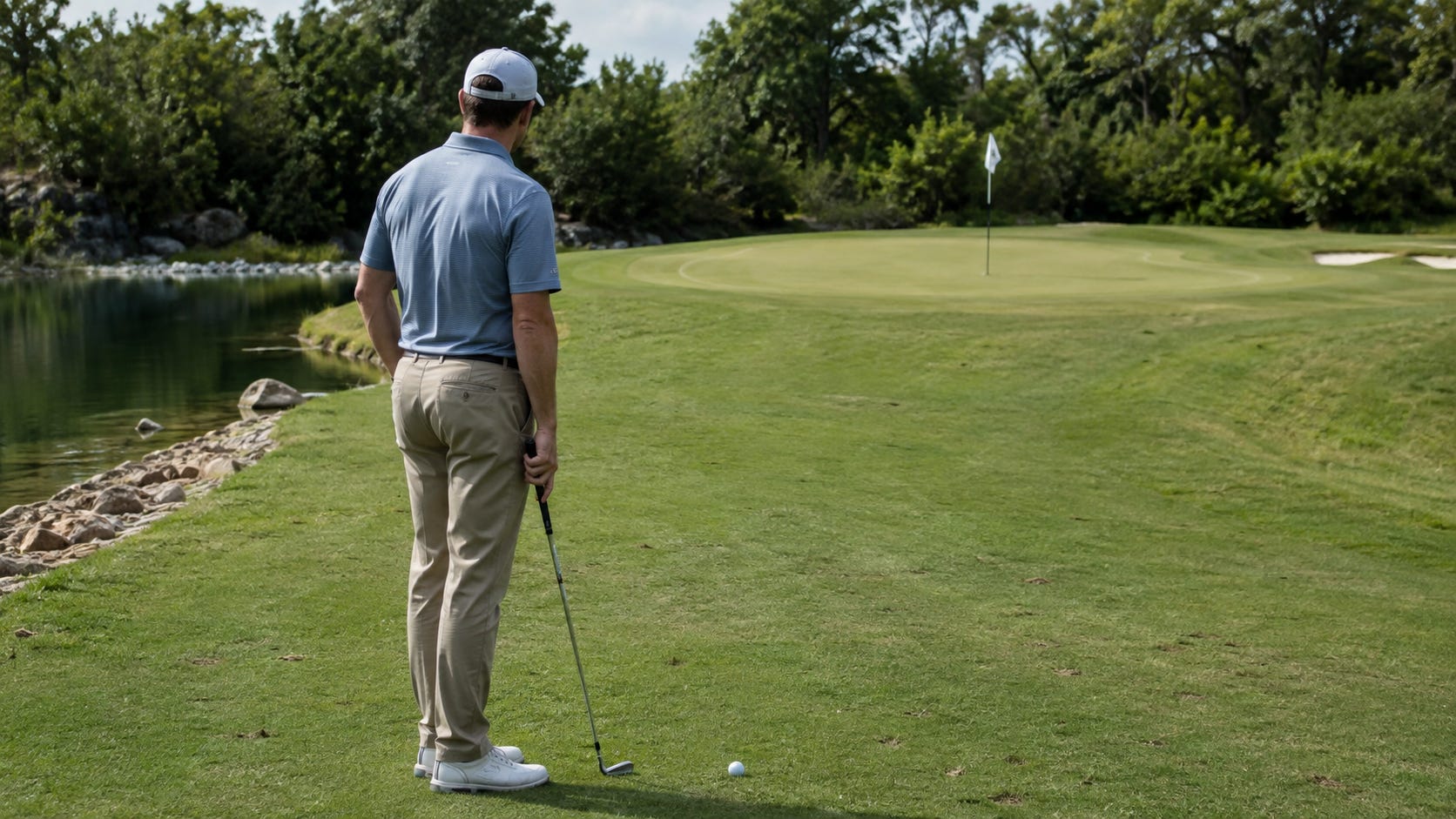
Most seasoned players stand over the ball and give the body too many instructions and the shot too little attention. I get it, the hands, hips, shoulders, legs, and club all have a job to do. Everybody is working overtime.
Meanwhile, the golf ball is still there and needs somewhere to go.
I spent many years working on a body movement, get if feeling pretty good on the range, and then carry that same thought onto the golf course. I can still remember laying in bed the night, worried that I might let it go, might forget. If keeping the shoulders quiet helped during practice, I wanted to make sure the shoulders stayed quiet when I played.
It made sense at the time.
The problem was that I could get so busy managing the shoulders that I stopped paying much attention to the shot. That is a lousy trade when distance is what you are trying to control.
The Body is Easy to Think About
Golf instruction gives us plenty to think about. Sometimes we need it if we are changing our setup, learning a different body motion, or fixing something that is clearly getting in the way. You have to spend time paying attention to what the body and club are doing and teaching pros are generally good at spotting issues.
That is what practice is for. But there is a difference between learning a body motion and hitting a shot. I think seasoned players get into trouble because we have such a big library of information available to us. We have been through enough lessons, drills, videos, bad rounds and range sessions that there is almost always another correction sitting there waiting.
A wedge comes up short and you remember something about your turn. A long putt rolls six feet past and now you are thinking about the length of the stroke. One poor strike and suddenly you are checking the hands on the way back. Before long you are no longer trying to hit a ball to a place or target. You are trying to perform the swing correctly and hoping the ball ends up somewhere useful.
I have done plenty of that. It always felt like the more important the shot, the more tempted I was to manage it. I know now that was backwards.
The Shot Needs More of Your Attention
Take a basic wedge shot, say 65 yards. You want the ball to land on a certain spot, take one small bounce and release toward the hole. There is a lot of useful information in that picture. You can see the landing point and have a sense of the trajectory. You also have a feel for the amount of energy the shot needs. You have played these greens before, you know roughly how the ball should react when it lands.
Now compare it with standing over the same ball thinking, slow shoulders. Maybe slow shoulders is working well for you on the practice range, I am not arguing with that. But which one gives your body a clearer job when it is time to play?
“Slow shoulders” describes something happening inside the body movement of the swing. Seeing the ball land on a target and release toward the hole describes what you are trying to make happen.
Those are not the same thing; I would rather give the trained motion a destination.
This Is Where Feel Comes Back In
Feel can sound vague if we are not careful. I don’t mean closing your eyes and hoping your instincts rescue you. I do not mean changing your technique and I certainly do not mean trying to manufacture some magical sensation before every shot.
I mean giving your attention something useful outside your body. For wedges, that could the landing spot, ball flight, trajectory, or finish distance. For putting, it might be the starting line, pace, entry speed or the place your want the ball to finish. Those things give the motion a reason. That matters because distance control is not just about making the same movement over and over. The movement has to respond to what the shot asks for.
A 45-yard wedge is not a 70-yard wedge with a smaller number written beside it. Or a 20-foot uphill putt is not the same task as a six-footer. Your body has to organize the right amount of motion and energy for the shot in front of you.
It is much easier to let that happen when your attention is actually on the shot.
Do Not Make “External Focus” Another Swing Thought
There is a trap here too. Seasoned players are good at turning anything useful into another rule.
You hear that you should focus on the target, so now every shot comes with a new command:
Focus on the landing spot.
Build your image.
Think target.
Do not think about body movement.
Now we have simply replaced one set of instructions with another. I guess it is improvement, but not much better. The landing point is not supposed to become another thing you have to perform correctly. Neither is pace or trajectory; they are all anchors.
Some days the image of the landing spot may be the strongest. On another day, the feel of the ball finishing beside the hole may be clearer. One seasoned player may respond to trajectory while another may respond better to pace, everybody is different.
The point is not to find the one perfect cue and keep it forever. The point is to notice where your attention is when you hit your best shots.
That is worth learning.
Try Three Balls
Here is a simple test the next time you practice, “um,” I mean train. Do not make a whole session out it.
Three balls is enough.
Choose one target.
With the first ball, use one body thought or cue you already know. Maybe it is “quiet hands,” “turn through,” “soft shoulders,” whatever tends to show up in your own game.
Then hit the shot.
With the second ball, use one club thought or cue. Maybe you picture the club moving at a certain speed, brushing the turf, or finishing in a certain place.
Hit that one.
Then take the third ball and leave the body and club out of it. Give your attention only to the intended result. See the landing point with a wedge, or feel the finishing pace with a putt.
Then hit it.
Afterward, rate each shot from 1 to 3 for three things:
Clarity.
Freedom.
Result.
Do not overthink the scoring. You are not trying to prove which method is scientifically correct. You are trying to notice the response.
Which one made the distance clearest?
Which one felt least crowded?
Which one let you react instead of managing you?
And this part matters: do not automatically assume the third ball has to win. Be honest, if a club thought gives you the clearest response that day, write it down. If a body cue genuinely helps, notice that too. You are gathering information about your own game, not trying to pass a test.
Where Was Your Attention on the Best One?
This is the question I would keep the answer too. Not, was the position of my backswing perfect? Not, did I use the correct focus strategy?
Just:
Where was my attention on the best rep?
I have found that my best shots usually have something in common. The shot feels clear before I pull the trigger and I know where I want the ball to go. And most importantly, I have an image of the target fresh in my mind as I pull the trigger.
When that image is clear, I do not have much room left for supervising the swing. And that is a good thing.
The work you do on your mechanics does not disappear because you stopped thinking about it. In fact, that is part of the reason your practiced it in the first place. You trained the movement so eventually you could use it.
Let Practice Do Its Job
There is a time to work on your body and there is a time work on the club. There is also a time to stop. But that can be difficult for seasoned players who have spent years trying to get better. We are used to fixing things. We are comfortable on the range especially when we have a problem to solve.
Standing over a shot and trusting what we already built can feel a little too quiet. But quiet is not careless, you can still be very specific about the shot. In fact, I think you should be.
See the landing point, feel the pace, or pick the trajectory. Commit to the starting line and know where you want the ball to finish. Give the mind something useful to do, then let the body handle the job you trained it to handle.
A great way to get started is to take a picture, or build an image of your chosen target. On a wedge shot that would be the landing spot. With a putt, after I diagnosed the line, and got a feel for the speed, I build and image of my target at or next to the hole.
This simplifies it, all I have to do is:
Diagnose the line, speed, or distance.
Align the club and get setup.
Look at my chosen target and build my image.
Bring my eye’s back to the ball and pull the trigger.
That is a much cleaner way to play.
One last piece of advice. While the process will be different for everybody, discover what yours is, and incorporate your pre-shot routine into ALL your training. Distance control training on the range, putter training on the practice green, and most important; training body movements at home.
If you add this layer to your training it will change the way you approach a golf shot for the rest of your golfing life.
Keep it simple!
Journal Prompt
Where was my attention on my best rep today?
And one more question worth an honest answer:
Do you perform better with a body cue, a club cue, or a clear image of the target?
Pay attention to that this week. You may learn more from three balls than another bucket of mechanical rehearsals.
Train trust, not swing thoughts.
Scott | Distance Control Coach
Train Differently
If you want to get more out of your practice, start by tracking what actually matters.
Free subscribers get practical training lessons each Tuesday on feel, trust, routine, reflection, and distance control inside 120 yards.
Paid members get full training sessions, practice plans, journal prompts, and course-transfer assignments designed to help you train week after week.
Keep using your journal to capture what clicked, what needs work, and what you will train next.